
Peg & Pole Tents for Sale in South Africa — Classic Event Tents, Proven Performance
Peg and pole tents are the event tent design that most South Africans grew up with — the peaked silhouette of a central king pole, the sweep of fabric from apex to pegged perimeter, the recognisable profile at agricultural shows, school sports days, community events, and outdoor markets across the country. The design has remained consistent for generations because it delivers exactly what large-area outdoor events in South Africa need: fast erection, generous covered space, predictable wind performance, and cost-effective coverage per square metre of floor area.
For event hire companies, government event operators, community organisations, and anyone who needs large covered outdoor space on open ground at a competitive cost, peg and pole tents offer the best value proposition in the commercial tent market. They erect faster than frame tents of equivalent area, cost less per square metre of covered space, and when properly tensioned and pegged handle South African weather conditions — including the Western Cape's summer south-easter and the Highveld's afternoon thunderstorms — with reliable confidence.
We manufacture peg and pole tents at our South African factory in Harrismith and supply them across all nine provinces.
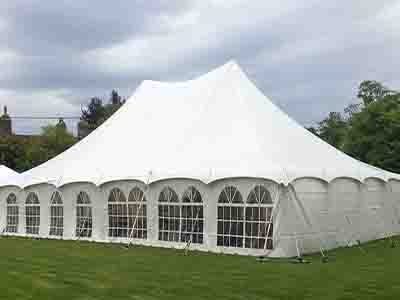
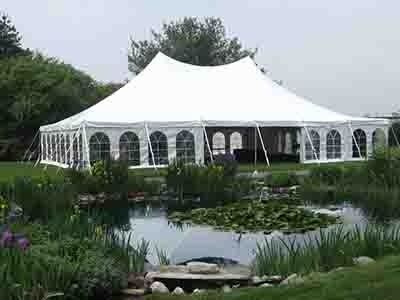
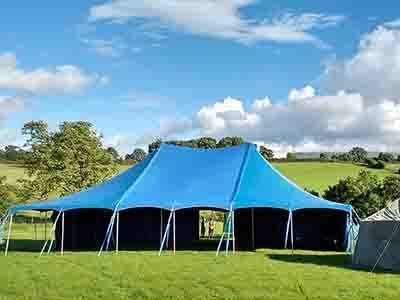
How Peg & Pole Tents Work
The peg and pole tent works through fabric tension. A central king pole pushes the tent apex upward. Perimeter side poles hold the eave line at the correct height. Guy ropes are staked into the ground to tension the fabric outward from the eaves, and a pegged skirt at the base of the tent fabric seals the perimeter. The entire structure is held in shape by the interplay of these opposing tensions — there are no rigid frame connections between poles.
This tension-based design creates a tent that is naturally aerodynamic. The peaked profile deflects wind upward and over the structure rather than presenting a flat resistance surface. A correctly pegged peg and pole tent with proper guy rope tension handles wind loads that would test an equivalent area of flat-canopy structure. The key is correct installation — the geometry of the tent must be right, the tensions must be even, and the pegging must be appropriate for the ground surface.
The design constraint to plan around is the requirement for open ground and pegging space. Peg and pole tents cannot be installed on hard surfaces — concrete, asphalt, tiles — without specialist modification. They also require clear space around the tent perimeter for the guy rope angles. On open ground these constraints are rarely an issue; at enclosed urban sites they may make a frame tent the more appropriate choice.
Peg & Pole Tent Specifications
Peg & Pole Tent Applications in South Africa
Frequently Asked Questions
1. How much do peg and pole tents cost in South Africa?
A. Peg and pole tents range from approximately R8,000 for a compact 6x6m unit to R45,000+ for large 12x24m configurations. They are generally 20–30% more cost-effective per square metre of covered space than equivalent frame tents. Contact us for a specific quote.
2. Can peg and pole tents be used on hard surfaces?
A. Standard peg and pole tents require ground pegging and are not suitable for concrete or asphalt without modification. For hard surface installations, frame tents with a ballast anchoring system are the appropriate product. Contact us to discuss if your site has mixed surfaces.
3. How long does it take to pitch a peg and pole tent?
A. A trained crew of four can pitch a 9x12m peg and pole tent in approximately 90 minutes to two hours. Peg and pole tents are generally faster to pitch than equivalent area frame tents because there are fewer connection points in the structure.
4. Do you manufacture peg and pole tents in South Africa?
A. Yes — we manufacture peg and pole tents at our Harrismith factory. Buying from a South African manufacturer means spare parts are available locally and custom sizes can be ordered without overseas lead times.
Get a Quote for Peg & Pole Tents in South Africa
Tell us your required size, event type, and ground surface. We provide a specification and quote within 24 hours.